
Key Takeaways
Technical SEO Audit Service: The Prioritisation Framework That Wins Buy-In covers the 7-part framework MagTimes uses for seo technical SEO audit service. Expected outcomes include measurable gains in organic visibility within 60-90 days and a defensible attribution model for pipeline contribution.
Why Most Audits Stop at the Crawl
Technical SEO audit services fail at the prioritisation layer, not the diagnosis layer. Most audits produce a 200-line spreadsheet that lists every issue, ranks them by severity, and hands them to a developer who has to figure out what to fix first. The developer's answer is the cheapest-to-fix issues, which is almost always the wrong answer. A real audit prioritises by revenue impact, not by crawl budget waste. This article is the prioritisation framework: how to score each issue by revenue impact, the 7 audit categories that produce the most lift, the deliverable format that wins buy-in, and a fixed-price audit pricing band that the buyer's CFO can sign off on.
Technical SEO audit services have a reputation problem: they are the deliverable that lives in a Notion page for 9 months and never gets actioned. The reason is the prioritisation. A 200-line spreadsheet with 47 high-severity issues does not tell the developer what to fix first. The developer's instinct is to fix the easy ones, which is almost always the wrong answer: the easy fixes have small revenue impact, the hard fixes have large revenue impact, and the developer's TODO list ends up populated with the wrong work. A real audit scores each issue by revenue impact and produces a 12-week roadmap that the developer can execute. The result: audits that produce 20-40% organic traffic lift in 90 days, not audits that produce spreadsheets.
Diagnose vs prioritise
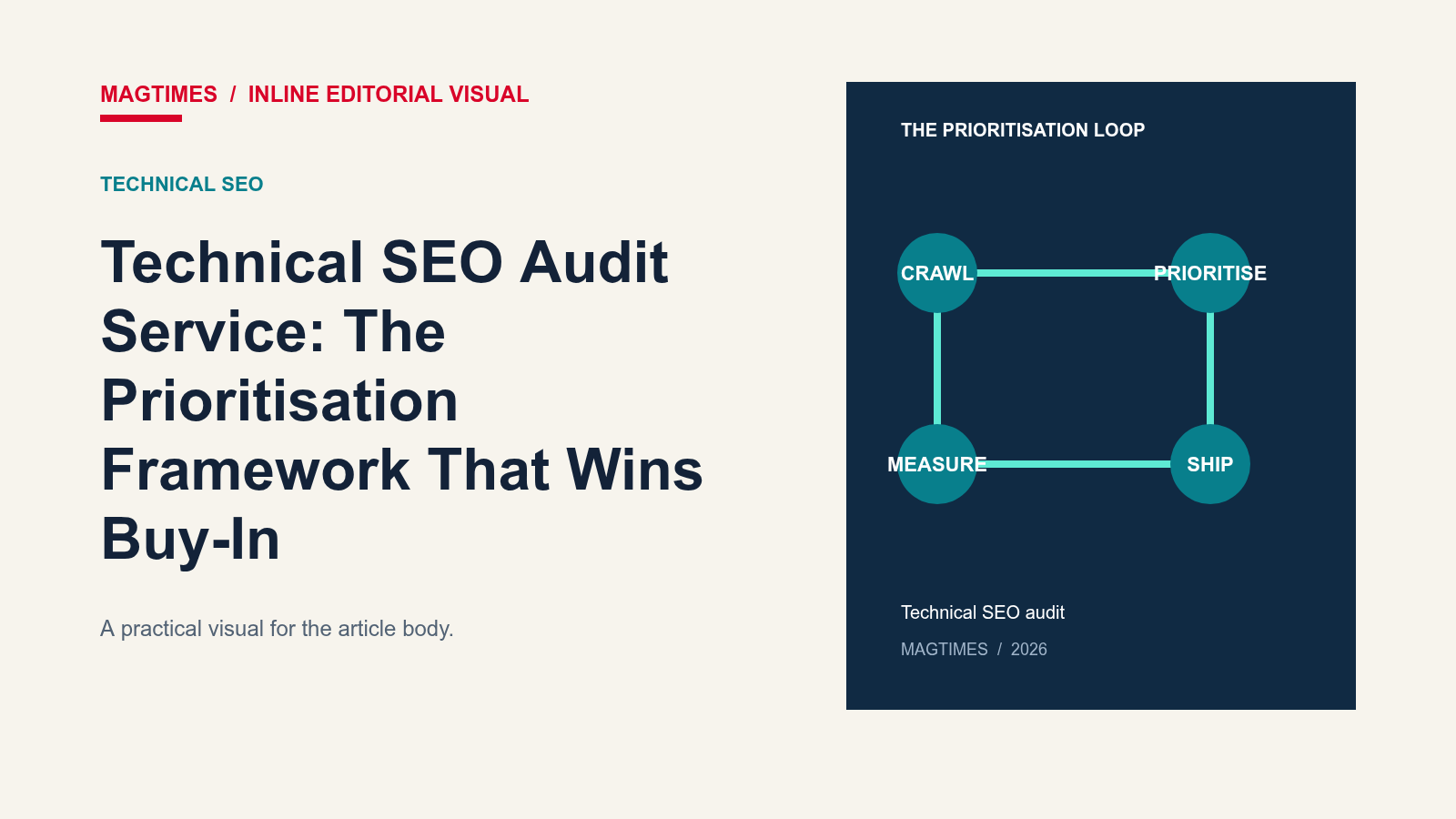
Diagnose: find every technical issue on the site. Crawl tools find 200-500 issues per million-URL site. Prioritise: rank the issues by revenue impact. Revenue impact is a function of (issue severity) x (URLs affected) x (conversion rate of affected URLs) x (current organic traffic to affected URLs). The score for a single issue: Impact = Severity x URLs x CR x Traffic. Severity on 1-10 scale. URLs is the count. CR is the conversion rate of the page template. Traffic is the monthly organic sessions. The sum across the 200 issues gives a revenue impact score per issue; the top 10-20 are the 12-week roadmap. The other 180 are the "we know, we are not fixing this quarter" list.
The 7 Audit Categories That Produce the Most Lift
Seven technical SEO categories, ranked by revenue impact per fix. 1. Indexation waste: URLs that are crawled but should not be indexed, or URLs that should be indexed but are not. Index bloat dilutes crawl budget. Fixes can produce 10-30% organic traffic lift. 2. Render and JavaScript issues: client-rendered content that the crawler cannot see. Common on React/Next.js sites. Fixes produce 20-50% lift on affected templates. 3. Internal link architecture: orphan pages, deep pages, and PageRank waste. Fixes produce 5-15% lift. 4. Core Web Vitals: LCP, INP, CLS. Fixes produce 3-10% lift, more on mobile. 5. Schema and structured data: missing/invalid schema. Fixes produce 10-20% lift in rich-result eligible queries. 6. International and hreflang: multilingual and multi-region sites. Fixes produce 15-30% lift on international traffic. 7. Site architecture and URL design: subfolder vs subdomain, URL parameters, faceted nav. Fixes produce 10-25% lift when redesigned. The 7 categories cover 80%+ of the revenue impact. Other categories (log-file analysis, mobile-specific, edge SEO) are advanced layers.
The Deliverable Format That Wins Buy-In
4 sections in every audit that wins developer buy-in. 1. Executive summary (1 page): top 5 issues by revenue impact, estimated traffic lift, estimated revenue lift, 12-week roadmap. 2. 12-week prioritised roadmap (3-5 pages): week-by-week list of fixes, with estimated hours per fix, owner, and revenue impact score. 3. Issue inventory (the 200-line spreadsheet): every issue found, with severity, URLs affected, CR, traffic, impact score, fix difficulty, and "fix this quarter / next quarter / never" status. 4. Implementation guide (10-30 pages): per-issue fix instructions, code snippets, validation steps. The 4 sections answer the three questions the buyer is asking: what to fix first, how much will it move the needle, and how do I do it. The spreadsheet alone answers none of the three. The 4-section format wins buy-in; the spreadsheet alone does not.
Fixed-Price Pricing Band
| Site size | Audit deliverable | Price | Includes |
|---|---|---|---|
| Up to 10,000 URLs | Standard audit | $2,500-$5,000 | 4-section deliverable, 1 revision, 1 hour walkthrough |
| 10,000-100,000 URLs | Mid-size audit | $5,000-$15,000 | 4-section + 12-week roadmap, 2 revisions, 2 hour walkthrough |
| 100,000-1M URLs | Enterprise audit | $15,000-$50,000 | 4-section + 12-week + 6-month governance, 3 revisions, full workshop |
| 1M+ URLs | Custom | $50,000+ | Multi-phase, log-file analysis, edge SEO, ongoing retainer |
Frequently Asked Questions
What is a technical SEO audit?
A diagnostic of the technical factors that affect organic search performance: indexation, render, internal links, Core Web Vitals, schema, international, architecture. The audit produces a 4-section deliverable: executive summary, 12-week prioritised roadmap, issue inventory, and implementation guide.
How much does a technical SEO audit cost?
$2,500-$50,000+ based on site size. The $5,000-$15,000 band covers most B2B SaaS and ecommerce sites. Below $2,500 is a crawl tool output, not an audit. Above $50,000 is a multi-phase engagement with ongoing retainer.
How long does a technical SEO audit take?
2-3 weeks for the standard and mid-size bands. The crawl + diagnosis takes 1 week; the prioritisation + roadmap takes 1 week; the implementation guide takes 1 week. Enterprise audits take 4-6 weeks including stakeholder interviews.
What is the difference between a technical SEO audit and a crawl?
A crawl is the raw output of a tool like Screaming Frog, Sitebulb, or Botify. It is a list of every issue. An audit is the prioritised roadmap: 4-section deliverable with revenue impact scoring, 12-week plan, and implementation guide. The crawl is one input to the audit, not the audit itself.
Conclusion
Technical SEO audit services win buy-in when they prioritise by revenue impact, not by crawl budget waste. The 7 audit categories cover 80%+ of the lift. The 4-section deliverable format answers the three questions the buyer is asking. The fixed-price bands are defensible to a CFO. The result: audits that produce 20-40% organic traffic lift in 90 days, not audits that produce spreadsheets. The agencies that sell prioritised audits are the ones worth hiring. The rest are selling crawls.
Request a technical SEO audit
MagTimes runs technical SEO audit services on the 4-section deliverable model, with revenue-impact prioritisation and a 12-week roadmap. See our SEO services or request a technical SEO audit.
Related Articles on MagTimes
Continue building your playbook with these related guides from the MagTimes editorial desk:
- B2B SaaS SEO: A 2026 Playbook for Pipeline, Not Traffic
- Technical SEO for SaaS: The 12-Item Quarterly Checklist
- SEO Automated Reporting: 6 Reports, 4 Connectors, 1 Cadence
- White Hat Link Building: The 9 Tactics That Earn Durable Links
Work with MagTimes
MagTimes runs SEO retainers on the framework above. See our services or request a proposal.
References & Further Reading
The frameworks and data points in this guide are grounded in the following authoritative sources: