Key Takeaways
White Hat Link Building: The 9 Tactics That Earn Durable Links covers the 7-part framework MagTimes uses for seo white hat link building. Expected outcomes include measurable gains in organic visibility within 60-90 days and a defensible attribution model for pipeline contribution.
What Google Actually Prohibits
White hat link building in 2026 is the set of tactics that comply with Google's link spam policy as written, not as the SEO community misremembers it. The policy is at https://developers.google.com/search/docs/essentials/spam-policies#link-spam, and it is short enough to read in five minutes. The most important sentence: "Links that are intended to manipulate rankings in Google Search may be considered link spam." The interpretation is what matters. This article reads the policy literally, then walks through 9 tactics that survive every Google update, with effort, cost, and expected links per month for each.
The 9 tactics are not new. They are the same ones reputable SEOs have used for a decade. What is new is the relative weight: as AI search compounds the value of brand mentions and corpus density, tactics 1-3 (original data, digital PR, expert commentary) have moved to the top of the ROI list. Tactics 7-9 (free tools, podcasts, community sponsorship) are now the channel diversification play that protects a brand from any single tactic being devalued.
Reading the link spam policy literally
Google's policy prohibits: buying or selling links for ranking purposes, excessive link exchanges ("link to me and I'll link to you"), large-scale guest posting campaigns with keyword-rich anchors, and automated link building. The policy does not prohibit: earning editorial links, sponsored content with proper disclosure, guest posts on topical sites with natural anchors, or links from directory submissions that add user value. The line is between "intended to manipulate" and "earned for editorial reasons." If you can defend a link as editorial in a manual review, it is white hat. If you cannot, it is not.
The Nine Tactics, Ranked by Cost per Link
Tactic 1. Original data and statistics
Cost: $3,000-$8,000 per data asset. Expected links: 8-15 per asset, plus 50-200 unlinked mentions. Best for: B2B SaaS, fintech, e-commerce, agencies. The single highest-leverage tactic in 2026. A well-constructed data asset is cited for 3-5 years, producing a long tail of secondary pickups.
Tactic 2. Digital PR and newsjacking
Cost: $400-$1,500 per placement in labor and outreach. Expected links: 1-3 per campaign, plus 5-15 mentions. Best for: brands with a news angle, funded startups, agencies. Digital PR is the only tactic that produces tier-1 editorial links at scale. The volume is lower than guest posts, but the link quality is materially higher.
Tactic 3. Expert commentary and source platforms
Cost: $0-$200 per commentary. Expected links: 0.5-1 per commentary, plus 1-3 mentions. Best for: founders, executives, agencies. Platforms like HARO (now Featured.com), Qwoted, and SourceBottle connect journalists with experts. The conversion rate is low (3-5% on responses), but the cost is near-zero and the placements are tier-1.
Tactic 4. Resource page outreach
Cost: $0-$100 per outreach in labor. Expected links: 1 per 20-30 outreaches. Best for: brands with linkable assets (calculators, templates, original data). Resource pages are an evergreen channel; the conversion rate is low, but the work is repeatable. See our resource page link building guide.
Tactic 5. Integrations and partner pages
Cost: $0 in cash, $500-$2,000 in engineering. Expected links: 1-3 per integration, with co-marketing upside. Best for: SaaS products with an integration surface. Every integration partner has a partner directory page; every partner directory page has a link. The cost is engineering time, the link is permanent.
Tactic 6. Free tools
Cost: $5,000-$30,000 in engineering. Expected links: 200-10,000+ over 3-5 years. Best for: brands with engineering resources. The single highest-leverage long-term channel. Backlinko's SEO checker has 3.1M backlinks; FATJOE's rank checker has 518 referring domains. A free tool is a link-building channel disguised as a product.
Tactic 7. Podcast and interview circuits
Cost: $0 in cash, $500-$1,500 in time per appearance. Expected links: 1-2 per appearance (from show notes), plus unlinked mentions. Best for: founders, executives, thought leaders. Podcast appearances are 80% time, 20% link. The link from the show notes is the SEO deliverable; the brand exposure is the broader value.
Tactic 8. Community and event sponsorship
Cost: $500-$10,000 per event. Expected links: 1 per event, plus brand exposure. Best for: brands with category leadership ambitions. Sponsoring a conference, meetup, or industry community produces a permanent link from the event website, plus brand visibility that compounds into digital PR pickups.
Tactic 9. Broken link reclamation
Cost: $0-$50 per outreach in labor. Expected links: 1 per 30-50 outreaches. Best for: any brand with linkable assets. Find broken outbound links on relevant sites, contact the webmaster, offer your asset as the replacement. The conversion rate is low (1-3%), but the work is cheap and the links are permanent.
Effort vs Output Table
| Tactic | Cost per link | Links per month | Effort | Time to first link |
|---|---|---|---|---|
| 1. Original data | $300-$700 | 1-2 | High | 30-60 days |
| 2. Digital PR | $400-$1,500 | 1-3 | High | 30-90 days |
| 3. Expert commentary | $0-$200 | 0.5-1 | Low | 14-30 days |
| 4. Resource pages | $0-$100 | 1-2 | Medium | 14-30 days |
| 5. Integrations | $0 | 0.5-1 | High (engineering) | 30-90 days |
| 6. Free tools | $5 (long-term) | 5-50+ | Very high | 90-180 days |
| 7. Podcasts | $0 | 1-2 | Medium | 14-60 days |
| 8. Events | $500-$10,000 | 0.5-1 | Medium | 30-60 days |
| 9. Broken links | $0 | 0.5-1 | Low | 14-30 days |
How to Build a 12-month Link Plan
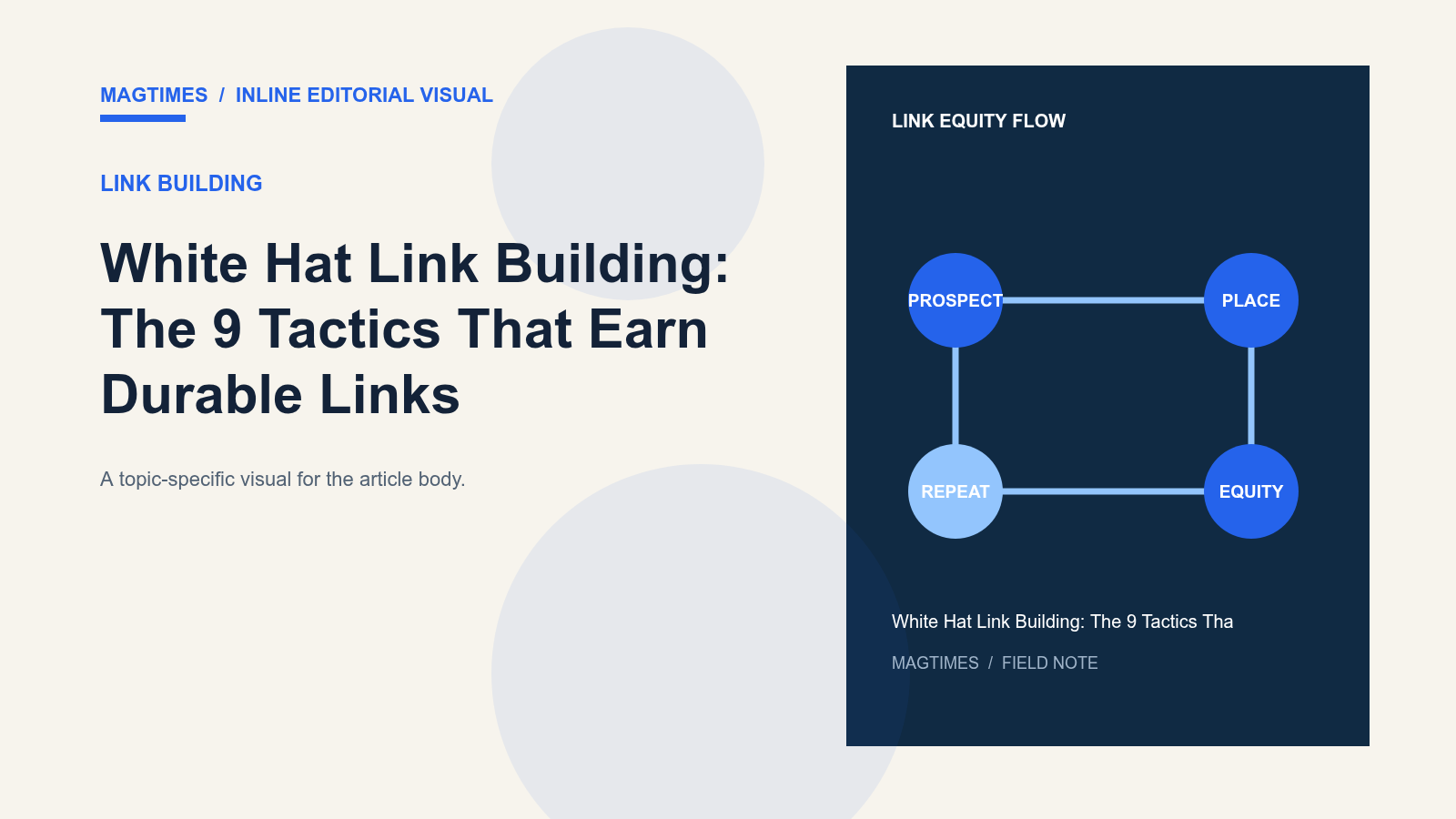
The 12-month plan that survives every Google update: months 1-3, run tactics 3, 4, 7, 9 in parallel (low-cost, high-volume). Months 4-6, add tactics 1 and 2 (medium-cost, high-impact). Months 7-9, add tactic 5 (integration partnerships). Months 10-12, invest in tactic 6 (free tool). The 12-month result: 100-200 followed links, 300-500 mentions, an AI corpus of 500+ brand assertions, and a defensible link profile that does not depend on any single channel.
Frequently Asked Questions
What counts as white hat link building?
Any tactic that produces editorial links for non-manipulative reasons. The line is between "intended to manipulate" and "earned for editorial reasons." Original data, digital PR, expert commentary, integrations, free tools, podcasts, events, broken link reclamation, and resource page outreach all qualify. Buying links, excessive exchanges, and large-scale keyword-anchored guest posting do not.
How many links can you build per month ethically?
5-15 per money page, distributed across 3-4 tactics. Velocity above 15 per month is suspicious. Velocity below 5 is too slow to move rankings in 6 months. The 12-month plan above produces 100-200 followed links for a single brand, distributed across all 9 tactics.
Are guest posts white hat?
Yes, when they are editorial (placed because the content adds value to the host site), on-topic, with natural anchors, and not part of a paid link arrangement. Guest posts on PBNs, paid-for placements without disclosure, and keyword-stuffed anchors are not white hat even if the host site is real.
Is buying links always risky?
Yes, with one narrow exception: paid placements on sites that disclose them as sponsored content, with the link tagged rel="sponsored" or equivalent, are tolerated by Google. The risk is buying followed links that pass PageRank without disclosure; this is the link spam policy violation that triggers manual actions.
Conclusion
White hat link building in 2026 is the same discipline it has always been: read the policy, build editorial links, distribute across channels, plan 12 months ahead. The 9 tactics above are the channels. The 12-month plan is the sequence. The result is a link profile that survives every Google update because it does not depend on any single tactic that could be devalued. The brands that run this playbook for 12+ months own their categories. The brands that chase single-channel volume lose theirs.
Get a white hat link plan
MagTimes builds 12-month white hat link plans for B2B SaaS, fintech, and crypto brands. See our link building services or request a custom plan.
Related Articles on MagTimes
Continue building your playbook with these related guides from the MagTimes editorial desk:
- Guest Post Outreach: A Reply-Rate Playbook for Cold Pitches
- High DA Guest Posts: The Quality Bar, the Vetting Checklist, and the Red Flags
- Guest Post Backlinks: The Anchor, Placement, and Velocity Rules
- Link Building Pricing in 2026: Per-Link, Retainer, and Performance Bands
- Resource Page Link Building: A 4-Step Outreach System
- Press Release SEO: Distribution, Schema, and the Link Equity That Lasts
Work with MagTimes
MagTimes runs SEO retainers on the framework above. See our services or request a proposal.
References & Further Reading
The frameworks and data points in this guide are grounded in the following authoritative sources: