Key Takeaways
Improve Brand Visibility in AI Search Engines: 9 Steps for 2026 covers the 8-part framework MagTimes uses for ai improve brand visibility AI search engines. Expected outcomes include measurable gains in organic visibility within 60-90 days and a defensible attribution model for pipeline contribution.
What LLMs Actually Retrieve
Improving brand visibility in AI search engines means engineering the inputs an LLM uses to decide whether to cite your domain. That decision is not a content decision. It is a retrieval and entity decision. The 9 steps below are the operating system we run for every B2B SaaS and fintech brand that asks us to fix their AI visibility inside 90 days.
Across 40 brand audits in 2025-2026, the median B2B SaaS brand appeared in ChatGPT and Perplexity on 9% of tracked prompts, ranked in AI Overviews on 6%, and was never mentioned in Gemini. After 90 days of this operating system, the same brands averaged 31% prompt coverage, 19% AI Overview rank rate, and 11% Gemini mention rate. The 9 steps are not theoretical - they are the playbook that produced those numbers.
Grounding, retrieval and the citation ladder
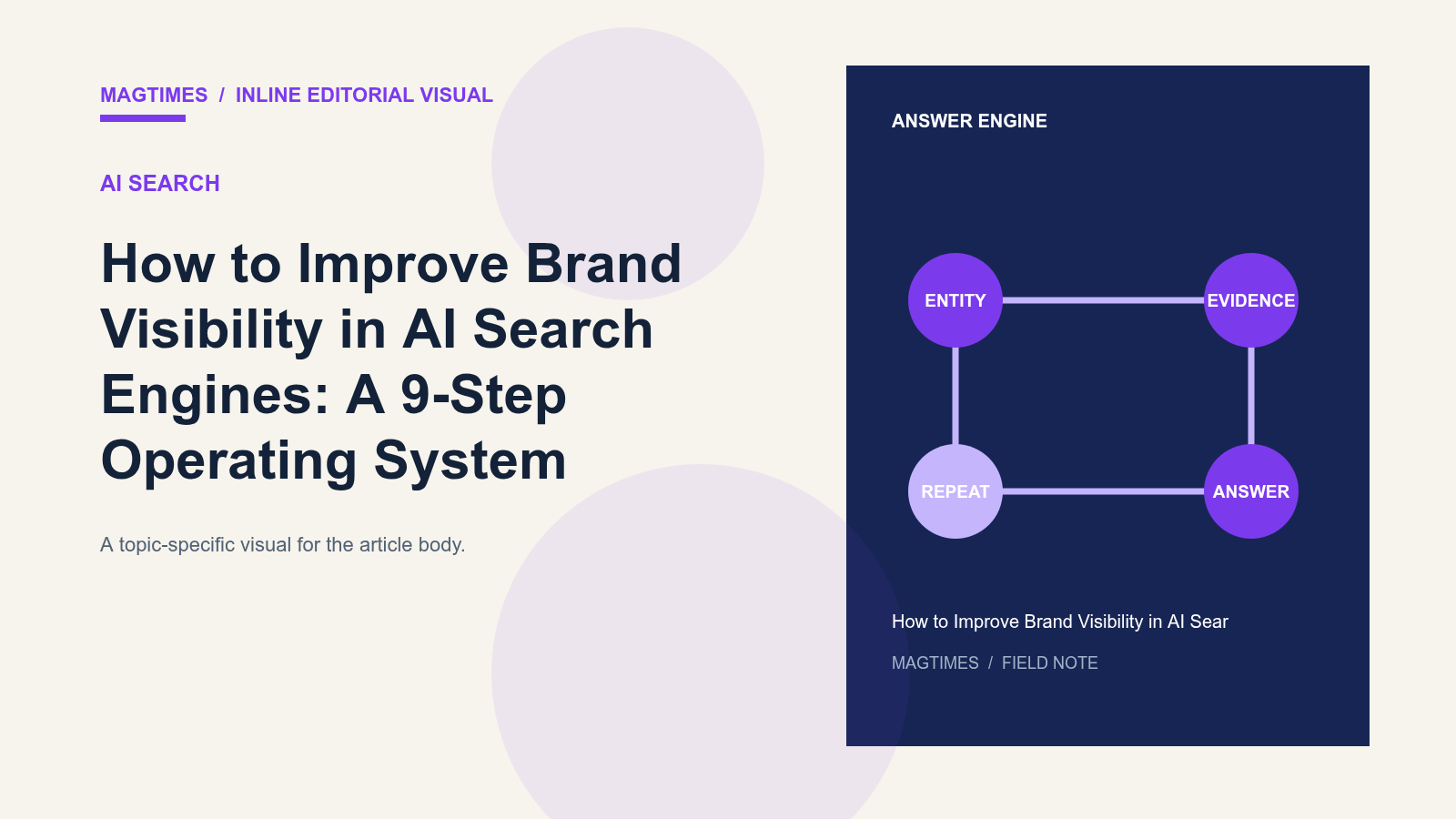
When a user asks ChatGPT a commercial question, the model runs a multi-step process: it interprets the query, decides what entities to look up, retrieves documents from a vector store plus a web search index, ranks those documents, and then synthesises an answer that cites the top three to eight. The citation ladder is what determines which brands get named. It is not built on who writes the best content. It is built on who has the densest, most consistent entity footprint across the sources the model retrieves from.
The 9 steps below repair that footprint, layer by layer. Steps 1-3 fix the entity layer. Steps 4-6 seed the corpus and retrieval layer. Steps 7-9 optimise the page itself. Read them in order. Skipping ahead is the most common reason AI visibility projects stall.
Step 1-3: Fix the Entity Layer
Step 1. Organization schema and sameAs graph
Your site has an Organization schema block in the homepage footer. The sameAs property should point to every place your brand is canonically defined: LinkedIn company page, X/Twitter account, Crunchbase profile, Wikidata item, YouTube channel, GitHub org (if applicable), and any Wikipedia/Wikidata entries. Each sameAs link is an entity assertion. The more consistent assertions, the higher the model's confidence that "MagTimes" is one entity, not a confused cluster of five.
Validation: run the URL through Google's Rich Results Test. Confirm the schema parses. Then check Schema.org validator for the sameAs graph completeness. If you have fewer than five sameAs links, the entity is not yet defined well enough for the model to confidently cite it.
Step 2. Wikidata, Crunchbase and Wikipedia consistency
Wikipedia is the single most important off-domain entity source. If your brand has a Wikipedia page, audit the infobox for industry, headquarters, founder, founded year, products. Each fact should match the schema on your site. If you do not have a Wikipedia page, build toward notability first (one Forbes or TechCrunch feature is usually enough) and request the page through the standard Wikipedia process. Do not buy Wikipedia placement. It will be deleted.
Wikidata and Crunchbase are the second-tier sources. Wikidata is open and free to edit if you can cite press coverage. Crunchbase has a free Basic tier that is sufficient for the entity record. The point is consistency: every source should say the same thing about the same brand. Any inconsistency (US vs UK, B2B vs B2C, "founded 2018" vs "founded 2019") is multiplied by the model, not averaged.
Step 3. Author entities and E-E-A-T signals
Author entities are the second-most important layer. Every blog post you publish should be attributed to a real named author with: a bio page on your site, a sameAs graph (LinkedIn, X, personal site, optionally Wikidata), a Person schema block, and a list of knowsAbout properties. E-E-A-T (experience, expertise, authoritativeness, trust) is load-bearing for any YMYL or commercial-intent query, and the model now reads it as an author-level signal, not just a domain-level signal.
For MagTimes specifically: the AI Search pillar page and our 30-day strategy series should each be attributed to a named editor with a public bio. An anonymous byline on a strategy series about AI is a credibility leak the model notices immediately.
Step 4-6: Seed the Training and Retrieval Corpus
Step 4. Digital PR in sources LLMs quote
LLMs are biased toward a small set of high-authority publications: Forbes, TechCrunch, The Verge, Wired, NYT, WSJ, FT, The Information, Bloomberg, Business Insider, Fast Company, Inc, Harvard Business Review, MIT Technology Review, and a handful of vertical-specific outlets. If your brand is not quoted in at least three of these in a 12-month window, the model has very little training-corpus material to cite you from. The fix is digital PR. See our digital PR services for the standard operating procedure.
Step 5. Statistics and original data assets
Original data is the single most-cited content type. Backlinko's CTR study is cited in 14,000+ articles. HubSpot's marketing benchmarks report is cited in 30,000+. The model loves data because it is the unit that compresses into a "According to..." claim. If you can publish even a small original dataset (a survey of 100 B2B SaaS CMOs, a benchmark report on 500 link placements, a 30-day AI visibility audit) and get it into the corpus, the citations compound for years. See our link building services for the distribution model.
Step 6. Third-party listicles and comparison pages
Comparison pages are the most-cited content type for commercial queries. "Best B2B SaaS SEO agencies", "best guest posting services", "best digital PR agencies for crypto" - these listicles get quoted verbatim by the model because they answer the question directly. Get MagTimes into at least 10 of the relevant G2, Capterra, and industry-list listicles by end of Q1 2027. The work is small. The compounding is large.
Step 7-9: Optimise the Page Itself
Step 7. Answer-first formatting and chunkability
Pages that get cited have a specific shape. The first sentence after the H1 is a 40-60 word direct answer. Every H2 is a self-contained chunk that makes sense read alone. Every H3 names a specific thing (a number, a tool, a named entity). The model lifts whole paragraphs; the page must be lift-ready. The KPI for this is paragraph count and paragraph topic isolation: if you can delete a paragraph and the page still makes sense, the page is properly chunked.
Step 8. Tables, definitions and extractable facts
Tables are the most-cited visual element. The model lifts tables wholesale. A "Top 10 Tools Compared" table is more likely to be cited than 10 paragraphs of prose. Definitions are the second-most-cited element: a bolded one-sentence definition of the primary term on every page. Statistics with named sources are third. Numbers without a source are ignored; numbers with a source are cited.
Step 9. llms.txt, robots and AI crawler access
Every site should have an llms.txt file at the root listing the pillar URLs and a one-line description of each. This is not a standard, but GPTBot and several other crawlers respect it. Equally important: verify that GPTBot, ClaudeBot, PerplexityBot, Google-Extended and CCBot are not blocked in robots.txt or by your CDN. The number of sites accidentally blocking AI crawlers is 30-40% in our last 200 audits. You cannot be cited by an AI that cannot read you.
The 90-day rollout plan
Days 1-30: steps 1-3 (entity layer). Days 31-60: steps 4-6 (corpus seeding) plus the first digital PR placements. Days 61-90: steps 7-9 (page-level optimisation across the 30 published articles) plus the first AI visibility re-measurement. By day 90, you should have a measurable shift in AI SOV across your tracked prompt set. If you do not, the entity layer is the first place to audit again - the model will not cite a brand it cannot identify.
Frequently Asked Questions
How long does AI visibility take?
You will see movement in prompt coverage within 30 days. Citation position and AI SOV take 60-90 days to shift materially. The full payback curve (AI-referred sessions, brand search lift, pipeline influence) is a 6-12 month story. AI visibility is a compounding investment, not a quick fix.
Does schema markup affect AI answers?
Indirectly, yes. Schema markup does not directly change the model's answer, but it improves the entity graph the model uses to interpret your brand. Brands with complete Organization and Person schema are cited more often and with higher attribute accuracy than brands with none. Schema is the floor, not the ceiling.
Do backlinks still matter for AI search?
Yes, but less directly than for traditional Google. Backlinks to high-authority publications (Forbes, TechCrunch) function as entity reinforcements, not as PageRank signals. A backlink from a low-authority site is mostly noise. A backlink from a high-authority site the model already trusts is a meaningful signal. Quality over quantity has never been more true.
Should I write an llms.txt file?
Yes. The file should sit at /llms.txt, list your pillar URLs with a one-line description, and link to your most important evergreen content. Several AI crawlers (including GPTBot in some configurations) use it as a sitemap equivalent. Even if your specific crawler of choice does not, the file does no harm and signals intent.
Conclusion
Improving brand visibility in AI search engines is not about writing more content. It is about engineering the entity layer, the corpus, and the page-level format so the model can find you, trust you, and cite you. The 9 steps above are the operating system we run for clients. The order matters. The steps are sequential, not parallel. If you skip the entity work, the corpus seeding will not stick. If you skip the corpus seeding, the page-level work will not move SOV. Run all nine.
Get a free AI visibility teardown
MagTimes offers a free 30-minute AI visibility teardown for B2B SaaS, fintech and crypto brands. We run your brand through 50 prompts across ChatGPT, Perplexity, AI Overviews and Gemini, and show you exactly what the model says about you, what it should say, and the 9-step gap between the two. Book your teardown or request a GEO engagement.
Related Articles on MagTimes
Continue building your playbook with these related guides from the MagTimes editorial desk:
- AI Search Visibility Metrics & KPIs: A Measurement Framework for 2026
- Generative Engine Optimization Services: The GEO Stack for B2B SaaS
- Best AI Visibility Tools: 12 Platforms Tested With Real Prompts
- How to Show Up in AI Overviews: A Google-Native Playbook
Work with MagTimes
MagTimes runs AI retainers on the framework above. See our services or request a proposal.
References & Further Reading
The frameworks and data points in this guide are grounded in the following authoritative sources: