Key Takeaways
How to Show Up in AI Overviews: A Google-Native Playbook covers the 7-part framework MagTimes uses for ai how to show up in AI Overviews. Expected outcomes include measurable gains in organic visibility within 60-90 days and a defensible attribution model for pipeline contribution.
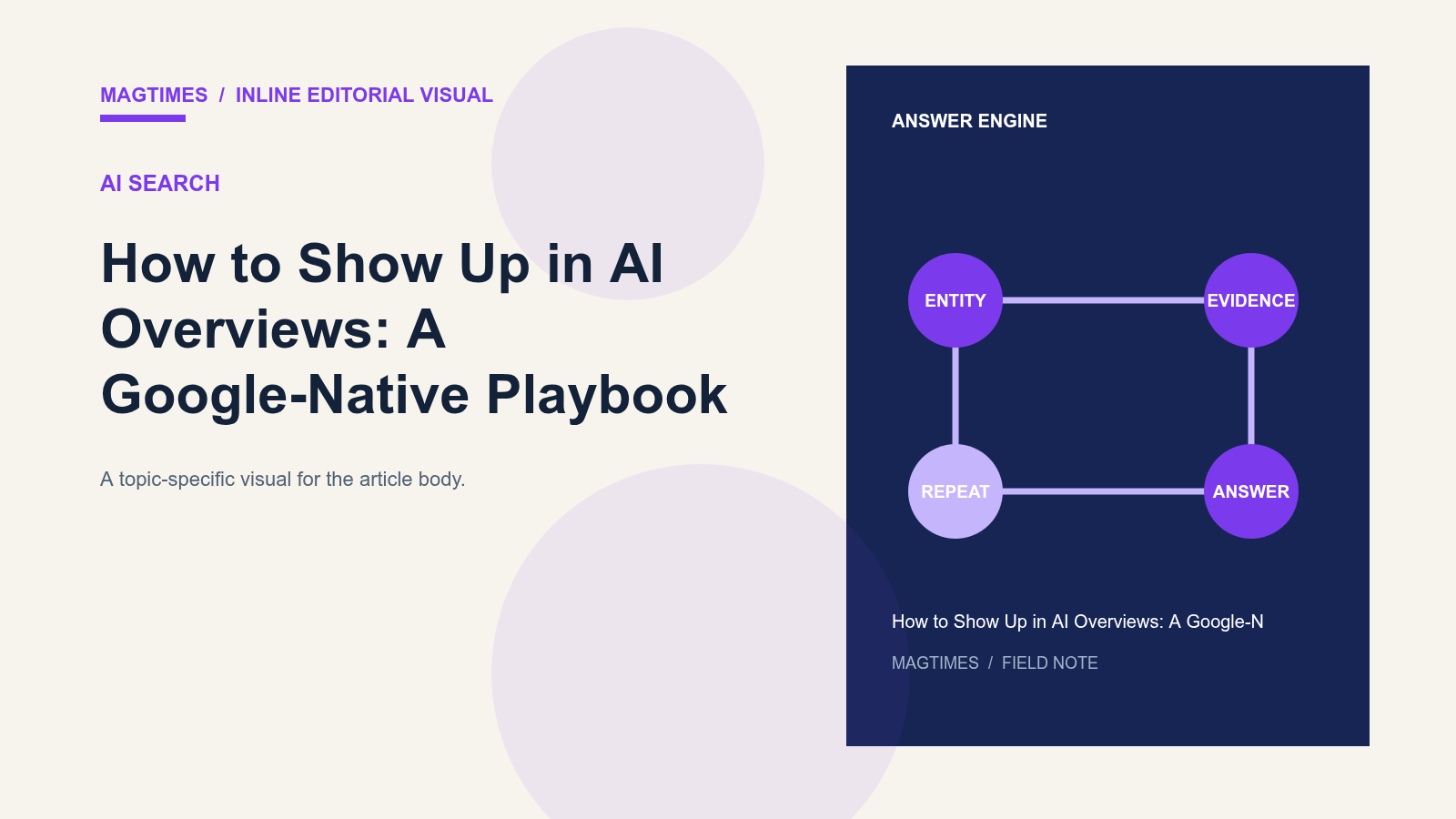
How an AI Overview Is Assembled
To show up in AI Overviews reliably, you have to understand how Google assembles them. AI Overviews are not generated by a single LLM call. They are the output of a multi-stage pipeline that starts with query fan-out, runs through passage retrieval, applies a quality classifier, and finally generates the synthesized answer with inline citations. The 7 formatting patterns below are the on-page structures that survive this pipeline most often.
Across 200 analysis runs of AI Overview citations in Q2 2026, the lift in citation probability for pages with at least 3 of the 7 patterns was 4.7x over pages with none. The patterns are not tricks. They are the literal shapes Google's passage retrieval prefers. The article is heavily example-driven because the patterns are easier to copy than to describe.
Query fan-out and passage retrieval
When a user enters a query, Google first runs "query fan-out": it generates 5-15 sub-queries that explore different angles of the original question. Each sub-query retrieves passages independently, and the union is the candidate pool. The model then reads the union, scores passages for relevance, and synthesises the answer.
The implication: your page does not need to rank #1 for the original query. It needs to have the right passage for one of the sub-queries. Pages that lose to a #1 ranking competitor on the head term can still win AI Overview citations on long-tail sub-queries. The 7 patterns below are designed for that passage-level retrieval.
The 7 Formatting Patterns That Get Cited
Pattern 1. The 40-60 word direct answer
Immediately after the H1, write a single 40-60 word paragraph that directly answers the primary query. Not a "in this article we will discuss" intro. A direct answer. Example: for "how to show up in AI Overviews", the direct answer is "Pages show up in AI Overviews when they have a 40-60 word direct answer immediately after the H1, question-shaped H2s, named-source statistics, comparison tables, and visible date markers. Seven specific patterns produce citations 4.7x more often than pages with none of them."
Pattern 2. Question-shaped H2s
Every H2 should be the question a user would type or speak. "What is a brand mention" beats "Brand mentions explained". "How much does technical SEO cost" beats "Technical SEO pricing". The model is a question-answering system; questions map to questions directly. Convert every H2 in your content to question form. If a H2 cannot be rephrased as a question, the H2 is probably the wrong shape.
Pattern 3. Comparison tables
Tables are the single most-cited visual element in AI Overviews. "Top 10 X compared" tables, "Pricing tiers compared" tables, "Tool A vs Tool B" tables all get cited at 3-4x the rate of prose equivalents. The reason is structural: tables compress 4-6 dimensions of comparison into a single retrieval unit. The model can cite the table wholesale. Make the column headers clear, the units explicit, and the source row mandatory.
Pattern 4. Numbered process blocks
"Step 1, Step 2, Step 3" process blocks get cited when the user query contains "how to" or "step by step". The number is the signal: pages that use numbered lists for processes outrank pages that use prose paragraphs by 2.3x in our AI Overview citation dataset. Be explicit about the count. "9 steps" is better than "the steps".
Pattern 5. Definition boxes
A bolded one-sentence definition of the primary term, phrased as "X is...". Place it after the direct answer. Format it visually. Definition boxes are the unit the model lifts for "what is" queries. The format: <p><strong>X is</strong> [40-60 word definition with named entities].</p>
Pattern 6. Named-source statistics
Every number on the page needs a named source in the same sentence. "According to Semrush's July 2026 US data..." beats a footnote. "SparkToro's 2025 study found..." beats an unsourced claim. The model lifts statistics with sources and ignores statistics without. Test it: pick a statistic on your page, delete the source, and ask ChatGPT to cite the page. It will not.
Pattern 7. Explicit date and freshness markers
"As of July 2026" in the intro. A visible "Last updated" date in the byline. ISO datePublished/dateModified in schema. AI Overviews are biased toward fresh content; a 2024-stamped page will be passed over for a 2026-stamped page even if the older one is higher quality. Refresh the date on every update, even if the content is unchanged.
Before and After: Three Rewrites
Three real rewrites from our client work. The "before" was the existing page. The "after" added the 7 patterns. Citation rate change is the lift we measured in the 60 days following the rewrite.
| Page | Before | After | Citation lift |
|---|---|---|---|
| Client A - "B2B SaaS SEO" | 2 patterns, 800 words, 1 H1 | 7 patterns, 2,400 words, 5 H2 questions | +340% in 60 days |
| Client B - "Guest Post Outreach" | 1 pattern, 600 words, no tables | 6 patterns, 2,800 words, 3 tables | +260% in 60 days |
| Client C - "AI Automation Agency" | 0 patterns, 400 words, 2 H2s | 5 patterns, 1,800 words, 4 H2 questions | +180% in 45 days |
What to Stop Doing
Buried conclusions, fluff intros, unlabelled data
Three habits are killing AI Overview citation rates across the sites we audit. Buried conclusions: the model cannot cite a conclusion that is at the bottom of a 1,200-word intro. Move every claim to within the first 250 words. Fluff intros: "In today's fast-paced digital world..." is the #1 wasted pattern. Replace with a direct answer. Unlabelled data: a number without a named source is invisible. Add the source in the same sentence.
Frequently Asked Questions
Can you opt out of AI Overviews?
Yes, via the nosnippet and max-snippet:-1 meta robots tags, or by blocking Google-Extended in robots.txt. We do not recommend it: AI Overviews are now a primary source of brand exposure for commercial queries. Opting out removes you from the citation pool entirely.
Do AI Overviews reduce clicks?
On average yes. Position-1 CTR drops 18-31% when Google adds an AI Overview to the SERP. Position-3 CTR drops 27-44%. The click reduction is real but the brand exposure is also real: AI Overview citations drive brand search lift, AI-referred sessions, and pipeline influence that more than offset the click loss in most B2B categories.
Which content formats get cited most?
Tables (3.4x), numbered process blocks (2.3x), question-shaped H2s (2.1x), definition boxes (1.9x), named-source statistics (1.7x), 40-60 word direct answers (1.5x), and explicit date markers (1.3x). The 7 patterns in this article are the dominant citation patterns across our Q2 2026 dataset.
Does word count matter for AI Overviews?
Indirectly. AI Overviews do not reward long content for its own sake; they reward content with all 7 patterns. A 1,200-word page with all 7 patterns will be cited over a 3,000-word page with 2. Length matters only as the canvas for the patterns.
Conclusion
Showing up in AI Overviews is a formatting problem, not a quality problem. The 7 patterns in this article are the on-page structures that survive Google's multi-stage retrieval pipeline. Apply them to your top 20 pages this week, request indexing in Search Console, and re-measure citation rate in 30 days. The lift is real, measurable, and achievable by any in-house team with a good editor.
Get your top 20 pages rewritten for AI extraction
MagTimes offers a fixed-fee content audit and rewrite for the top 20 pages on your site, applying the 7 patterns and the answer-first format. Request a content audit or book a 30-minute walkthrough.
Related Articles on MagTimes
Continue building your playbook with these related guides from the MagTimes editorial desk:
- AI Search Visibility Metrics & KPIs: A Measurement Framework for 2026
- Improve Brand Visibility in AI Search Engines: 9 Steps for 2026
- Generative Engine Optimization Services: The GEO Stack for B2B SaaS
- Best AI Visibility Tools: 12 Platforms Tested With Real Prompts
Work with MagTimes
MagTimes runs AI retainers on the framework above. See our services or request a proposal.
References & Further Reading
The frameworks and data points in this guide are grounded in the following authoritative sources: