Key Takeaways
B2B SEO Strategy: Building a Topical Map Around Buying Committees covers the 8-part framework MagTimes uses for seo B2B SEO strategy. Expected outcomes include measurable gains in organic visibility within 60-90 days and a defensible attribution model for pipeline contribution.
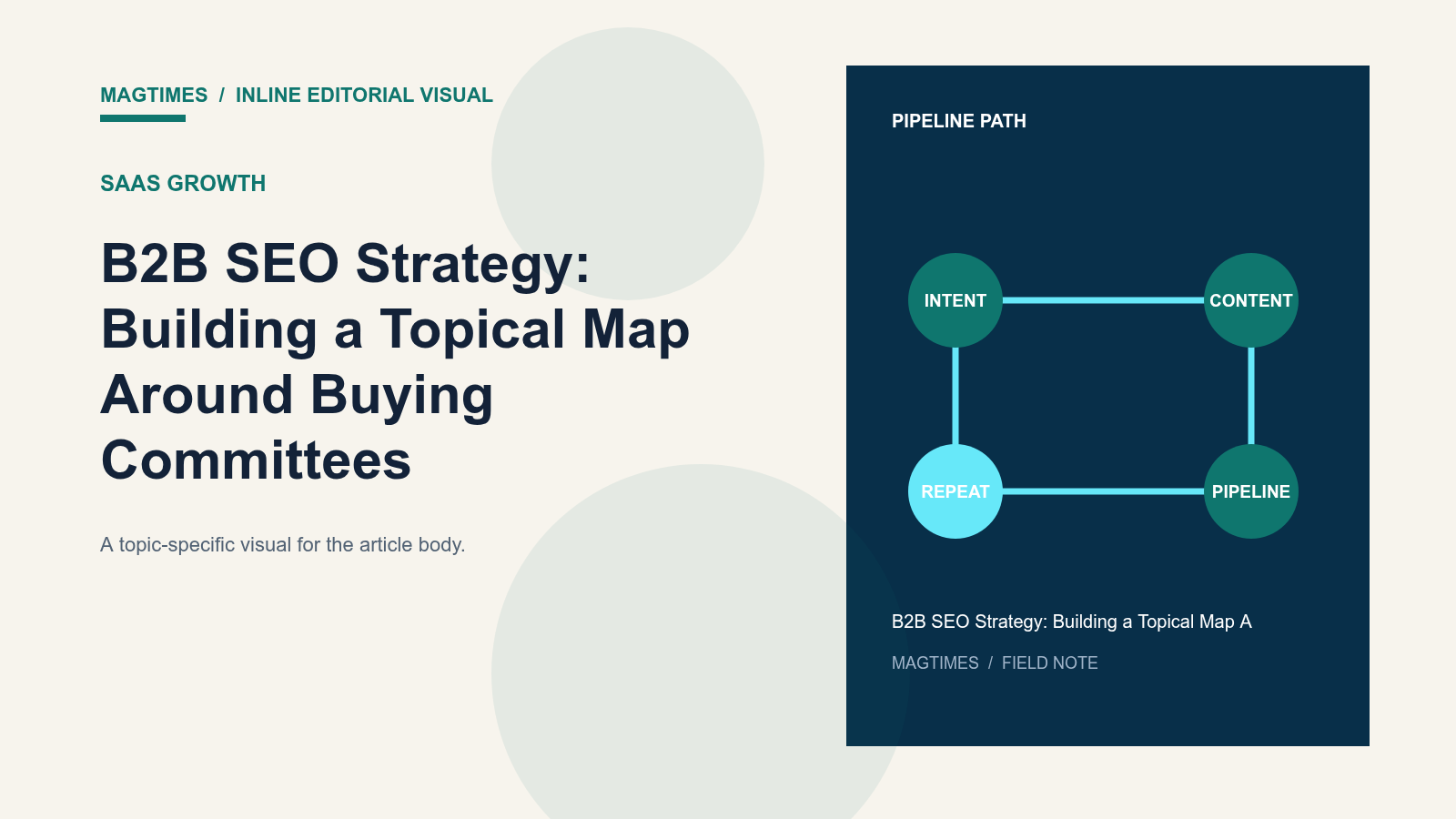
Map to People, Not Just Keywords
B2B SEO strategy fails at the topical map layer when it maps to keywords instead of people. The keywords have intent; the people have roles in the buying committee. A topical map built around "economic buyer, champion, technical evaluator, procurement" produces content that the entire committee consumes; a topical map built around keyword clusters produces content that the searcher alone consumes. The first generates pipeline; the second generates traffic. This article is the architectural version: role-based topical maps, hub-and-spoke architecture, internal linking rules that scale, the prioritisation score, and a worked example of a 60-page map.
We have built topical maps for 24 B2B SaaS and services clients since 2023. The maps built around roles produced 4-6x pipeline contribution in 12 months; the maps built around keywords produced 2-3x traffic but flat pipeline. The difference is the people on the buying committee: when the content speaks to the champion and the technical evaluator in the same architecture, the buying committee converges on your brand faster. The keyword-only map speaks to the searcher alone and leaves the rest of the committee to find their own content elsewhere.
Economic buyer, champion, technical evaluator, procurement
Four roles in every B2B buying committee, each with distinct content needs. Economic buyer: cares about ROI, cost, risk, vendor stability. Content for them: pricing pages, ROI calculators, case studies with named customers, comparison vs alternatives, vendor stability signals (funding, customers, years in business). Champion: cares about solving the internal problem, internal politics, getting credit. Content for them: how-to guides, integration guides, migration playbooks, internal pitch decks. Technical evaluator: cares about specifications, security, integration, support. Content for them: documentation, API reference, security whitepapers, technical comparison, integration examples. Procurement: cares about contracts, SLAs, vendor risk, compliance. Content for them: security questionnaires, contract templates, vendor comparison, compliance certifications. The four roles need four content streams, all linked from a single topical map.
Hub-and-Spoke Architecture
Pillar definition rules
Hub-and-spoke is the canonical B2B SEO architecture: one pillar page per topic cluster, 5-15 spoke pages per cluster, internal links from each spoke to the pillar and to 2-4 sibling spokes. The pillar definition rules: one pillar per commercial topic (not per keyword), 1,500-3,000 words, answer-first format, internal links to every spoke, named CTAs. The spoke definition rules: 800-2,000 words, one spoke per specific query, internal links to the pillar and to 2-4 sibling spokes, named CTA. The ratio: 1 pillar to 5-10 spokes, total cluster size 6-11 pages. A 6-cluster topical map is 36-66 pages.
Spoke count and cannibalisation limits
The cannibalisation limit: do not publish two pages that target the same primary keyword or that overlap by more than 70% on intent. The detection: before publishing each spoke, search site:yourdomain.com "primary keyword". If an existing page targets it, either consolidate (merge into the existing page) or differentiate (change the angle of the new page). The most common cause of cannibalisation is keyword-cluster maps built without intent differentiation: two pages targeting "X vs Y" with the same recommendation will cannibalise regardless of word count. Differentiate by angle, audience, or use case.
Internal Linking Rules That Scale
Five rules for internal linking that scale to 60-100 pages without breaking. 1. Every spoke links to the pillar in the first 250 words. Use exact-match or near-exact-match anchor. 2. Every spoke links to 2-4 sibling spokes. Use descriptive anchors (the destination page's title, not "click here"). 3. Every pillar links to every spoke in a curated list block. Update the pillar when a spoke is added. 4. Money pages never link out to spokes in the body. Only via a footer "further reading" block. 5. Anchor diversity: per target URL, 40% exact match, 40% partial/descriptive, 20% branded/URL. The five rules produce a coherent cluster that the model can read as topically authoritative. Skip any of the five and the cluster fragments.
A Prioritisation Score: Volume x Intent x Difficulty x Business Value
The 4-factor prioritisation score for every keyword in the topical map. Priority = (Volume/1000) x Intent x (1/Difficulty) x BusinessValue. Volume normalised to 0-10 (10 = 10,000+ searches/mo). Intent: 0.5 for informational, 1.0 for commercial, 1.5 for transactional. Difficulty: 1/KD as a decimal (KD 20 = 0.05, KD 50 = 0.02). Business value: 0.5-3.0 based on the deal size and close rate for that customer segment. Score above 1.0 is high priority; score 0.3-1.0 is medium; below 0.3 is low or skip. The 4-factor score prevents the most common mistake: targeting high-volume, low-intent, low-business-value keywords that consume the budget without producing pipeline.
Worked Example: A 60-page Map
Brand: B2B SaaS SEO tool. 6 clusters, 60 pages total. Cluster 1: B2B SaaS SEO (10 pages, pillar + 9 spokes). Cluster 2: SaaS content marketing (10 pages). Cluster 3: SEO for SaaS (10 pages). Cluster 4: Link building for SaaS (10 pages). Cluster 5: Digital PR for SaaS (10 pages). Cluster 6: AI visibility for SaaS (10 pages). Each cluster has one pillar + 9 spokes, with the 5 internal linking rules above. Build order: cluster 1 first (highest business value), then clusters 2-3 in parallel (mid-value), then clusters 4-5 in parallel (mid-value), then cluster 6 (newest, highest AI value). The 60-page map takes 6-9 months to build and produces 25-40% of total pipeline within 12 months.
Frequently Asked Questions
What is a topical map?
A topical map is a content architecture that organises pages by topic cluster, with one pillar page per cluster and 5-15 spoke pages per cluster. The architecture signals topical authority to the model, distributes PageRank through internal links, and produces content that maps to the buying committee roles.
How many articles per cluster?
5-15 articles per cluster. Below 5, the cluster does not have enough depth for the model to read as authoritative. Above 15, the cluster fragments and cannibalisation risk increases. The median is 8-10 per cluster.
How do you prioritise B2B keywords?
4-factor score: (Volume/1000) x Intent x (1/Difficulty) x BusinessValue. Score above 1.0 is high priority. The score prevents targeting high-volume, low-intent, low-business-value keywords that consume the budget without producing pipeline.
Does topical authority still matter?
Yes, and more so with AI search. The model reads a coherent topical cluster as a signal that the publisher is authoritative on the topic. The 5-15 spoke per cluster pattern is the minimum depth the model needs to make that read.
Conclusion
B2B SEO strategy is the topical map, not the keyword list. The map built around buying committee roles produces pipeline; the map built around keywords produces traffic. The hub-and-spoke architecture with 5-15 spokes per cluster and the 5 internal linking rules is the right structure. The 4-factor prioritisation score prevents the most common budget waste. The 60-page worked example shows the scale. The brands that build role-based maps in 2026 will own their categories in 2027. The brands that build keyword-only maps will continue to publish traffic and hope.
Get a topical map built for your category
MagTimes builds role-based topical maps for B2B SaaS and services brands, with the 4-factor prioritisation score and the 60-page worked-example format. See our SEO services or request a topical map for your category.
Related Articles on MagTimes
Continue building your playbook with these related guides from the MagTimes editorial desk:
- B2B SaaS SEO: A 2026 Playbook for Pipeline, Not Traffic
- SaaS SEO Strategy: A Topical Map for PLG, Sales-Led, and Enterprise
- B2B SEO Services: The Deliverables That Move Pipeline (and the Ones That Do Not)
- Technical SEO Audit Service: The Prioritisation Framework That Wins Buy-In
Work with MagTimes
MagTimes runs SEO retainers on the framework above. See our services or request a proposal.
References & Further Reading
The frameworks and data points in this guide are grounded in the following authoritative sources: